
Oleksii Andriiuk
CEO Posimos
Food Cost in a Restaurant: The Complete Guide to Calculating and Reducing the Cost of Your Dishes
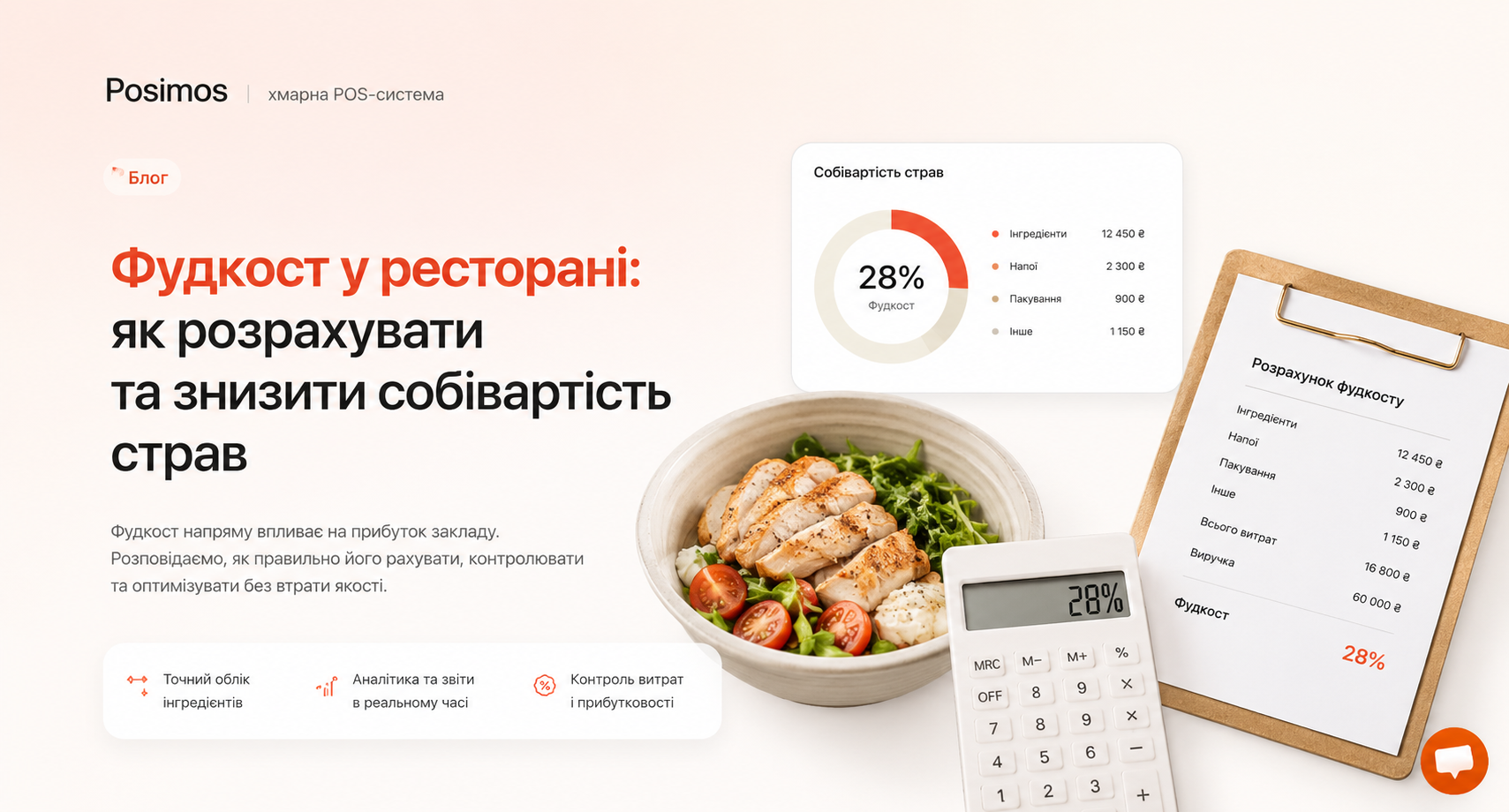
Table of contents
You can have a packed dining room every night and still break even. In HoReCa, this is the classic trap: revenue climbs, but the money in your account doesn't. Almost always there's a single culprit — uncontrolled food cost. It's the metric that quietly decides whether a venue actually earns or just puts on a busy show. Let's break down what food cost is, how to calculate it at both the dish and the venue level, what percentages count as healthy, and which steps genuinely lower your cost of goods without sacrificing quality.
What food cost is and why it decides a venue's fate
Food cost is the share of ingredient cost in the selling price of a dish or drink, expressed as a percentage. In plain terms: out of every dollar a guest pays you, how many cents go toward the products.
Why is this the metric that matters most? Because in the restaurant business, food is the largest controllable cost line. You can't quickly change rent, salaries, or utilities — but you control the cost of your dishes every single day, through recipes, portions, purchasing, and tracking waste. For most venues, the cost of products runs at 25–35% of revenue, and every extra percentage point here hits your profit directly.
Cost of goods and food cost are two different things
The most common beginner mistake is confusing two figures:
- Dish cost (cost of goods) is the total spend on ingredients for a single portion, in money (for example, $80).
- Food cost is the percentage ratio of that cost to the selling price (for example, 30%).
Two dishes with the same cost of goods can have wildly different food cost if their prices differ. That's why, for management decisions, you always look at both numbers together — never just one.
A high food cost eats your margin even when the venue is running at full capacity. So controlling your cost of goods isn't an accounting formality — it's the main lever of profitability.
The food cost formula: at the dish level and the venue level
There are two formulas, and you can't mix them up.
Food cost of a single dish
Food cost (%) = (Ingredient cost / Selling price) × 100%
Example. A salad that uses $80 of products sells for $265:
80 / 265 × 100% = 30.2%
The dish's food cost is 30.2%. It's a quick indicator of how "expensive" a specific menu item is for you.
Food cost of a venue over a period
The overall food cost is calculated differently — accounting for the movement of products through your storeroom:
Food cost (%) = (Opening inventory + Purchases − Closing inventory) / Revenue × 100%
Why is it essential to account for inventory? Because if you calculate using purchases alone, the figure gets distorted. Imagine you bought a month's worth of products in advance — based on "bare" purchases, your food cost would shoot through the roof, even though half the goods are still sitting in storage. The formula with inventory shows how much product you actually consumed over the period, not how much you bought.
Reverse calculation: price from a target food cost
You can flip the formula and use it for pricing:
Selling price = Cost of goods / Target food cost
Example. The cost of a pasta portion is $62, and the target food cost is 28%:
62 / 0.28 = $221
This approach guarantees the margin you need is built into the price at the menu-design stage, rather than being guessed at by eye.
Target food cost by venue type
There's no single "correct" number — the benchmark depends on the format. Rough ranges:
| Venue type | Target food cost |
|---|---|
| Coffee shop | 15–22% |
| Fast food | 20–28% |
| Café | 25–30% |
| Pizzeria | 25–32% |
| Full-service restaurant | 25–33% |
| Fine dining | 28–35% |
For most full-service venues, the healthy range is 25–33%. If a category's food cost regularly climbs above the upper bound, that's a warning sign: the dish is either running at a loss or hanging on the edge of profitability.
Why a single percentage across the whole menu is a mistake
It's tempting to set one target — "30% on everything" — and not fuss over it. But that doesn't work:
- Drinks and sides have a low food cost and pull the average down. Coffee with a cost of $12 priced at $70 is a food cost of about 17%.
- Kitchens working with premium products (steaks, fish, seafood) naturally carry a higher food cost, and that's fine as long as the contribution margin in dollars is high enough.
That's why food cost is always considered alongside the portion's contribution margin — that is, how many dollars a dish earns above its cost of goods. An item with a 35% food cost but a $250 contribution per portion is often more valuable than one with an 18% food cost and a $25 contribution.
The technical and costing card — the foundation of an accurate calculation
Accurate food cost is impossible without a recipe (technical) card for every dish. A well-built technical card contains:
- a list of all ingredients with gross weight (before processing) and net weight (after);
- the price per unit of each ingredient;
- the yield of the finished portion;
- the resulting cost of goods.
Loss coefficients — the thing people forget most often
Products lose weight during processing: trimming vegetables, shrinkage when cooking meat, reducing sauces. If you ignore this, your cost of goods will be understated, and your real food cost will turn out higher than your calculations show. For example, fish can yield 40–50% waste when cleaned and filleted — you have to enter the gross weight into the card with these losses factored in, otherwise you'll undercount the cost of goods by nearly half.
The "little things" count too
Salt, oil, spices, the sauce for plating, packaging for delivery — all of it seems like pennies, but across thousands of portions it turns into a tangible sum. A well-built technical card accounts for even a packet of salt and a delivery container.
One ingredient goes up in price — and everything has to be recalculated
Raw-material prices change constantly. When, say, butter gets more expensive, you need to recalculate the cost of every dish that uses it. Doing this by hand is agony, which is why in a restaurant POS system a change to the purchase price of a single ingredient automatically recalculates the cost of goods for every related dish. One edit, and the whole menu is current again.
10 proven ways to lower your food cost
- Strict portion control. Kitchen scales aren't a whim — they're a necessity. Over-portioning by 10–15 grams quietly eats your margin, and there's no way to catch it "by eye."
- Working with multiple suppliers. Review purchase prices regularly and compare offers. A single supplier means no leverage to negotiate.
- Receiving and weighing at delivery. Short-counts and mis-sorted goods are a common source of hidden losses. Weigh what you receive.
- Tracking and minimizing write-offs. Work on a FIFO basis ("first in, first out"), watch expiry dates, and record every write-off: spoilage, kitchen mistakes, tasting samples.
- Seasonal and local products. Seasonal produce is cheaper and better; adjust the menu to what's available right now.
- Reviewing recipes. Sometimes swapping one expensive ingredient for a worthy alternative lowers the cost of goods without any loss of flavor.
- Forecasting purchases from sales history. Buy for real demand, not "just in case" — that way you cut the write-offs from surplus.
- Menu analysis (menu engineering). Remove items that consistently run at a loss.
- Teaching the kitchen to think about cost. A cook who understands what over-portioning costs is more frugal than one who never sees it.
- Proper storage. Maintaining the right temperatures and product separation directly reduces spoilage.
Case in point. One venue lowered its food cost from 38% to 29% in just two months. No magic in the recipe: they implemented tracking in a POS system, adjusted prices to actual cost of goods, removed loss-making items, put scales in the kitchen, and brought order to storage. Nine percentage points is the difference between "barely surviving" and "confidently earning."
Menu engineering: make your menu profitable, not just cheap
Menu engineering is the analysis of a menu along two axes: popularity (how often it's ordered) and profitability (how many dollars a portion brings in). Every dish falls into one of four categories:
- Stars — popular and profitable. The pride of the menu; they belong at the top.
- Workhorses — popular but low-margin. Ordered often, earn little.
- Puzzles — profitable but rarely ordered. Good potential that isn't being realized.
- Dogs — unpopular and unprofitable. The menu's dead weight.
Let's recall the key number: a portion's contribution margin = Selling price − Cost of goods. Our $265 dish with an $80 cost of goods gives $185 of contribution — and it's exactly this money that covers rent and salaries and builds your profit.
What to do with each category
- Stars — protect quality, place them prominently on the menu, recommend them in the dining room.
- Workhorses — carefully raise the price or lower the cost of goods without dampening demand.
- Puzzles — spotlight them through promotions, descriptions, and server recommendations.
- Dogs — remove them or rework them drastically.
You should review your menu at least quarterly — raw-material prices change constantly, and yesterday's "star" easily becomes today's "workhorse."
Why calculating food cost by hand loses to automation
Spreadsheets look tidy right up until prices start creeping. And creep they do, every week. No manager can physically keep up with recalculating hundreds of items by hand after every change in purchase prices — and the spreadsheet quietly turns into a museum piece.
Here's how the Posimos POS system solves it:
- Automatic cost-of-goods calculation. Posimos computes the food cost of every dish based on technical cards and actual purchase prices — with no manual recalculations.
- Actual, not theoretical, food cost. Tracking your storeroom, write-offs, and inventory counts gives you the real picture. See how it works: the gap between theoretical food cost (from technical cards) and actual food cost (from inventory counts) is precisely your losses, theft, and over-portioning.
- Statistics and ABC analysis. The system shows you which items are stars and which drag you down, with no hand-built menu-engineering spreadsheets.
- Real-time control. You see food cost daily or weekly — not once a month, when the losses have already happened and nothing can be recovered.
POS system N also calculates cost of goods, but the real value isn't in the formula — it's in tying your storeroom, technical cards, and sales together in one place, where the numbers update themselves.
Common mistakes when working with food cost
- Calculating from purchases alone without accounting for storeroom inventory — the figure jumps around and means nothing.
- Ignoring loss coefficients during processing — cost of goods is understated, and reality is painful.
- Excluding "minor" ingredients and delivery packaging — at scale, that's real money.
- A single target % across all menu categories — drinks and premium kitchens live by different rules.
- Monitoring once a month instead of weekly — you react when it's already too late.
Frequently asked questions
What's a normal food cost in a restaurant?
For most full-service venues, the healthy range is 25–33%. The benchmarks depend on the format: coffee shop 15–22%, fast food 20–28%, café 25–30%, restaurant 25–33%, fine dining 28–35%. There's no single "correct" number — what matters is keeping your food cost within the healthy range for your specific type of venue and looking at it together with contribution margin in dollars.
How do I calculate the food cost of a single dish?
Divide the cost of all the dish's ingredients by the selling price and multiply by 100%. For example, a salad with an $80 cost of goods priced at $265 has a food cost of 30.2%. It's important to account for all ingredients (including salt, oil, and spices) and the loss coefficients from processing the product, otherwise the cost of goods will be understated.
How do I set a dish's price using a target food cost?
Divide the dish's cost of goods by the target food cost expressed as a decimal. If the pasta costs $62 and the target is 28%, the price = 62 / 0.28 = $221. This reverse calculation guarantees that every menu item builds in the margin you need right at the pricing stage.
What's the difference between a dish's cost of goods and food cost?
Cost of goods is the total spend on ingredients for a single portion, in money. Food cost is the percentage ratio of that cost of goods to the selling price. Two dishes with the same cost of goods can have different food cost if their prices differ, so for decisions you need to look at both numbers.
How do I lower food cost without hurting quality?
The most effective steps: strict portion control with scales, tracking and minimizing write-offs (FIFO, expiry control), reviewing purchase prices and working with suppliers, forecasting purchases from sales history, and menu analysis that removes loss-making items. Automating your tracking in a POS system lets you see your actual food cost daily, rather than once a month, when the losses have already happened.
Start controlling your food cost today
Food cost isn't a one-time calculation — it's a daily discipline. As long as you're calculating cost of goods by hand, the numbers go stale faster than you can enter them. Posimos takes this routine off your plate: technical cards, your storeroom, write-offs, statistics, and the actual food cost of every dish — all in one system that updates itself. Review the pricing and choose a plan to see cost control in action and stop losing margin where it can so easily be saved.